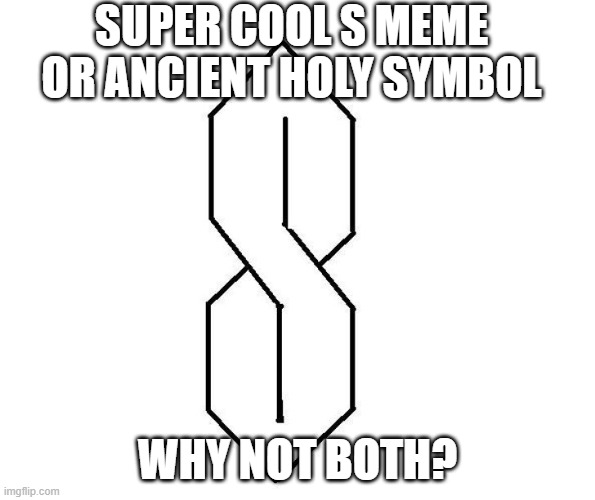
How many of us have seen or drawn the super cool ‘S’ or the Stussy S before? You know the one, the graffiti looking S that you find randomly in the bathroom or in the back of your textbook randomly, yeah that one. Personally, I know I’ve done my fair share of notebook scribbles or even stumbled across them while flipping through my textbook back in school haha. Recently, there have been a lot of questions around this mysterious but super cool S and for good reason. What does it actually mean and where did it come from?
Wikipedia has traced its origins back as far back as being a part of 1980’s subculture and being tied together with graffiti. While that’s the more recent interpretation of it there are other theories that point to its elusive history going as far back as the creation of the Coat of Arms of Jerusalem in 1099 or even to Shakespeare’s description of Queen Elizabeth’s baptism.
S of Spiritus
The singular ‘S’ that we’re all familiar with is more than a random doodle you do while you’re bored in class or in public bathroom stalls. There is a theory suggesting that the similar interwoven S can be found in medieval armory designs, including the Arms of Jerusalem.
Yes, that random scribble you’ve been doing since the fifth grade could be connected to ancient history. Interwoven within the chains of the Arms of Jerusalem, the cool ‘S’ can be found woven into its inner chain. In this connotation, the letter ‘S’ symbolizes spiritus, the Latin word for ‘Spirit’.
SS or Sanctus Spiritus
While the singular ‘S’ represents Spiritus in language of symbolism, adding another S into the mix changes its meaning. If you’re thinking of Spiritus Spiritus, you’d be half right. On the contrary, the double changes the meaning to Sanctus Spiritus, which means ‘Holy Spirit’.
An interesting example would be in Queen Elizabeth’s baptism in Shakespeare’s play, History of Henry VIII.
In Act IV Scene 1, we’re taken to a street in Westminster where two men are meeting before Queen Elizabeth’s baptism. As the coronation procession begins, several high ranking individuals, which includes – Marquess Dorset, Suffolk, and Norfolk – appear wearing collars that bear an engraving of SS on them.
SSS The Holy! Holy! Holy!
While double S means Sanctus Spiritus, triple S or SSS acts as a triple acclamation. This takes on the meaning sanctus x3, meaning Holy! Holy! Holy!. Because the triple esses takes on the appearance of 888, the Greeks associated it with Jesus. “Why?” you may ask, it’s because of
Jesus’s Greek name, Iesous.
This is due to the ancient Greek practice of isopsephy, where each letter has a numerical value that’s attached to it. So when you apply that ancient practice to Iesous, you get this letter breakdown:
- I (Iota) = 10
- E (Eta) = 8
- S (Sigma) = 200
- O (Omicron) = 70
- U (Upsilon) = 400
- S (Sigma) = 200
When you add it all together, you get 888.
By a similar concept, when you add up the gematria value of the Aramaic word for Jesus Christ (אשו מְשִׁיחָא) you get 666. Here’s the break down starting with Christ, or Mshikha/מְשִׁיחָא:
- מ (Mem) = 40
- ש (Shin) = 300
- י (Yod) = 10
- ח (Chet) = 8
- א (Aleph) = 1
When you add this up, you have 359.
And here’s Jesus or Ishu/אשו:
- א (Alef) = 1
- ש (Shin) = 300
- ו (Vav) = 6
- ה or ו (final ו suffix) = 6
This when added together will give you 307.
When you add up the gematria value אשומְשִׁיחָא together, we get 666. Humorously enough, this makes an interesting contrast between 888 and 666 when you think about 666 and its Christianity connotation.
So what does this mean?
While the true origin of the super cool S or Stussy S remains uncertain, there are a few theories. Some researchers connect it to the 1970s and 1980s school and alternative culture, and others point to older artistic or symbolic motifs that resemble the symbol. Since actual evidence remains limited, many earlier connections remain as theories instead of being fact.


Leave a comment